Author as Producer
- Dave Macey

- Dec 4, 2021
- 4 min read
I am unashamedly a fanboy of Walter Benjamin. His essay The Work of Art in the Age of Mechanical Reproduction had a profound effect on me of when I read it as an undergraduate. I was amazed by the vision and the analysis within that essay and went on to influence my own development as a photographer quite strongly.
So, it is with this reverence for his work that I started to read The Author as Producer and my initial analysis of the text left more questions than answers. Such as there is a strong element of political left wing influences within this essay with a focus on social classes and how this essay could only really be applied to the genre of documentary photography and reportage. However, these fell into place when the essay was placed within the context of being delivered to The Institute for the Study of Fascism in 1934 Paris and so solves the mystery of their being such a strong left wing bias.
But there was something else in this text. Benjamin mentions “But now let us follow the subsequent development of photography. What do we see? It has become more and more subtle, more and more modern, and the result is that it is now incapable of photographing a tenement or a rubbish heap without transforming it… in front of these photography can now only say ‘how beautiful’…. It has succeeded in turning abject poverty itself, by handling it in a modish, technically perfect way, into an object of enjoyment. For it is an economic function of photography to supply the masses, by modish processing, with matter which previously eluded mass consumption.”
There are two main points in this portion of text. The first is the appropriation of beauty and how photographing an object or a scene is then transformed into a subject that is attractive and attention grabbing. For example, the Oskar Barnack Award, a prestigious award that is given in conjunction with Leica, focuses on social documentary and reportage, which by their very nature reflect human society, demonstrates how beauty is mixed with drama and tension.
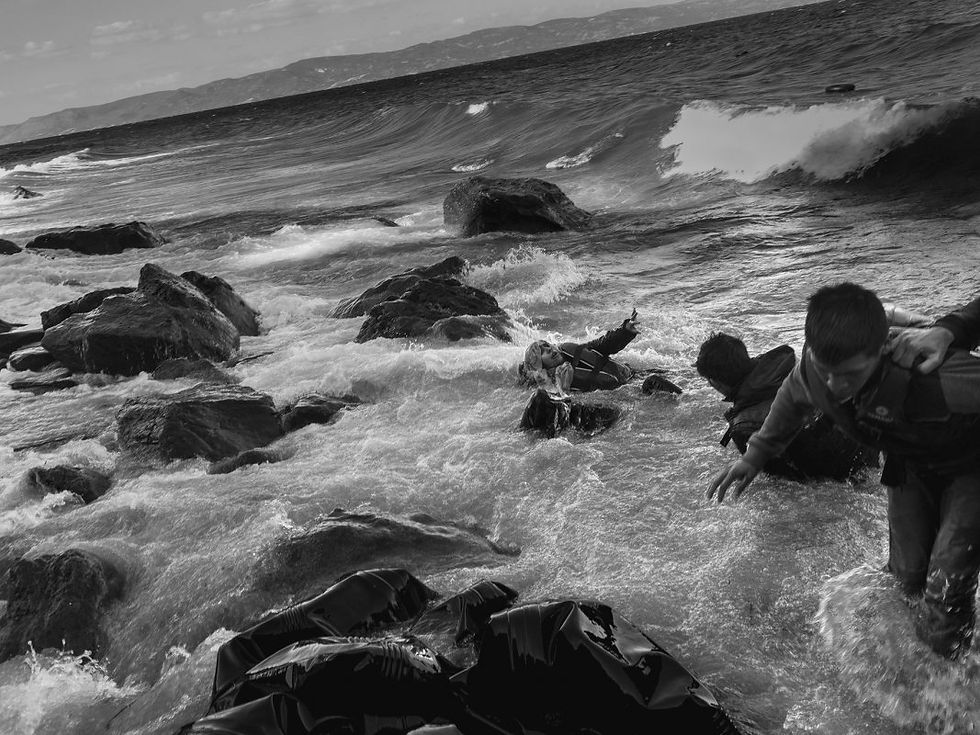
One such series of images are by Enri Canaj, a photographer with the prestigious Magnum photo agency, with one of his images reprinted here and shows migrants arriving by boat on the shores of the Greek Island of Lesbos. It is full of drama and actually seems reminiscent of Robert Capa’s images of the Normandy beach landings in 1944 and is an image that captivates and transfixes the viewer.
However, the image has an element of classicalism and beauty to it, which is purely down to the aesthetic choice of using black and white instead of colour. Compositionally it also uses the rule of thirds, another vestige of classicalism. But it also achieves a sense of distance, it resonates on a different level than what it would if it was in colour.
It is this sense of distance that gives the image an extra appeal. It is well known that if a scene is harrowing, then lessening its impact increases its appeal and the viewer is more likely to study the image for longer. By lessening the confrontation of people risking their lives and barely surviving makes the photograph more palatable and easier for the image to be digested by contemporary culture.
It is this that brings me to the second point I would like to make, how the image is distributed and consumed by mass culture. Just imagine if the image was in colour, was more harrowing or even showed people not surviving the crossing of the Adriatic sea. How likely is that image to be shared on social media? Do you think that Instagram and Facebook would allow the image to be distributed? How many people would complain about the photograph? It’s not a case of Enri Canaj not being able to capture such an image, indeed I am sure that he has, but those images would be rejected by society rather than by personal taste.
And this is the point that Walter Benjamin made 87 years ago. For a photograph to gain traction in our modern world it needs to be presented in a modish, technically perfect way, and transformed into an object of enjoyment. If the image was more harrowing, more emotionally demanding than it is, then it would be less engaging and so less enjoyable. I don’t enjoy seeing the struggle of surviving such an arduous crossing, but I do enjoy the questions it raises, such as, what happened to the people 6 months later? Have they resettled? Where are they now? How has making the crossing affected them, mentally and physically?
But to reach these questions the scene needed to be presented in a way for the viewer to be receptive to it, it needed to be presented in a modish way, which is to be a fashionable and modern way. When this image was taken in 2015 the migrant crisis in Europe was gathering pace, it was a hot topic that was drawing a lot of attention from the press, and it became “fashionable” to cover the emerging story. Then to have the image distributed through the internet added to the sense of modernity, that it was using the technology that was new and exciting whilst at the same time of being an expectation. Indeed, without this technology so much of our modern life would be different and it is the sense of speed and immediacy that makes it feel modern, something that is so very different from even just 40 years ago. The culmination of both of these factors, the speed of the delivery of information and the covering of the most pertinent issues of the day gives the genre of documentary photography a sense of modality which makes it embedded into our modern culture.
And thank you to Walter Benjamin for providing another piece of inspiration.


Comments